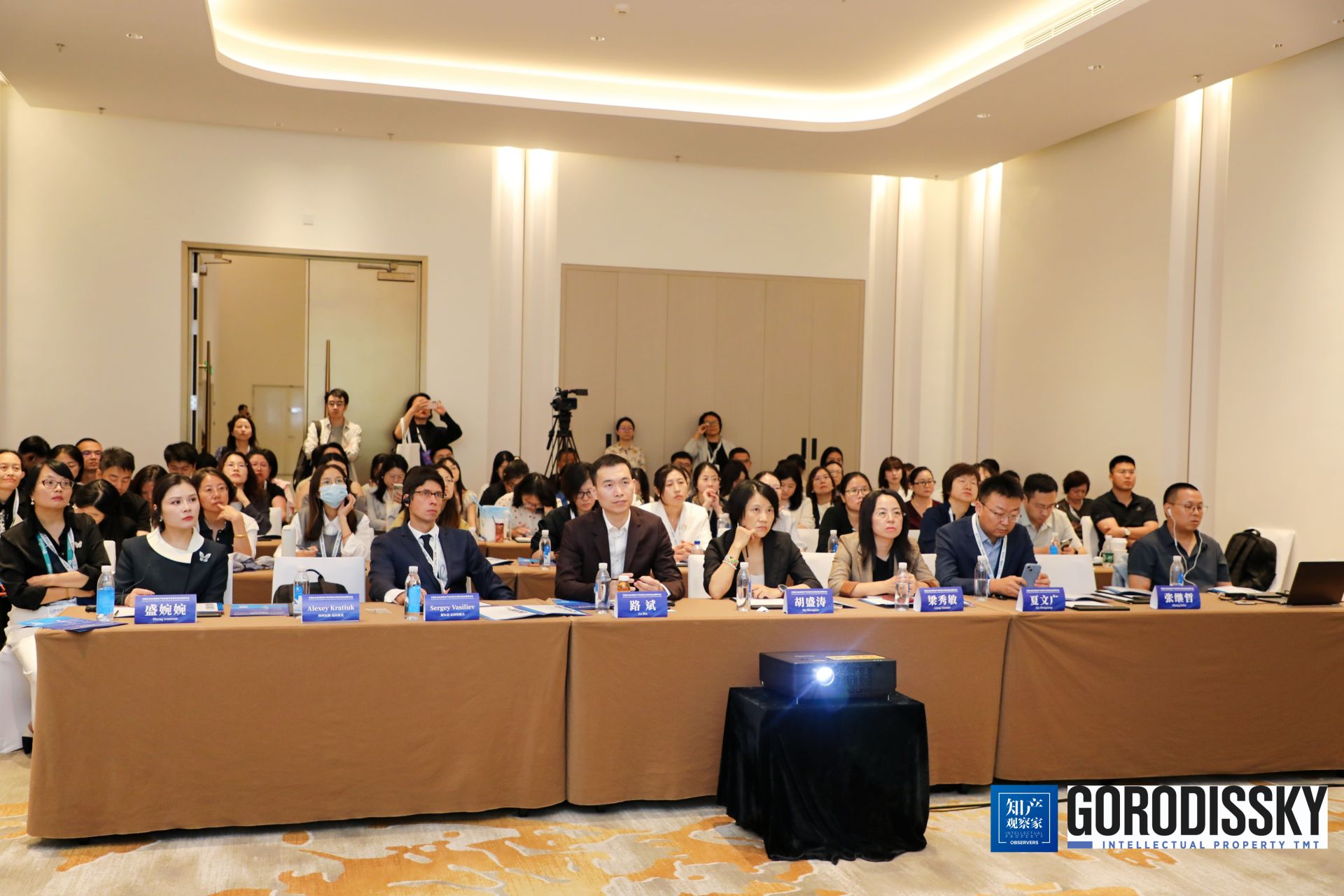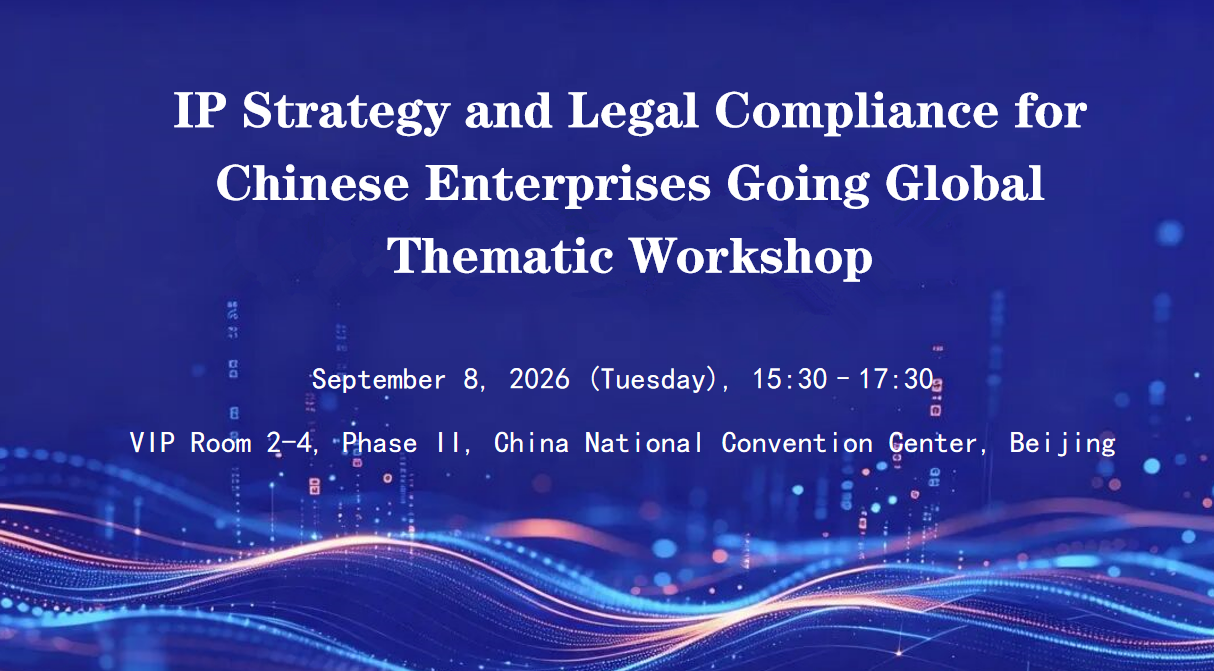


The 15th China Intellectual Property Annual Conference (CIPAC 2026) wrapped up in Beijing on September 8–9, 2026, drawing more than 8,000 delegates from over 40 countries and regions—spanning government, industry, academia, research and end users—for candid conversations on AI-driven IP governance, global SEP governance and overseas IP strategy for Chinese enterprises. The event proved a high-caliber meeting ground for government-industry dialogue, cross-sector exchange and international collaboration.
RWS, a global specialist in AI-enabled, full-lifecycle IP management, hosted a booth at the conference and presented its integrated global IP management solutions to Chinese innovators. James Lacey, CEO of Protect(the Group's IP Division), delivered during the main forum a keynote presentation titled "The Accountability Premium in the Age of AI," advancing the accountability premium as a defining proposition of the moment—one that struck a chord with attendees and prompted lively debate.
Two years on, Intellectual Property Observers is pleased to sit down once more with James Lacey. Our conversation explores the shift in Chinese companies' overseas patent strategies from defensive positioning to asset operation, the data governance gaps that undermine global portfolio management, the application and governance of AI in IP, and the forward-looking path toward deeper integration of brand protection and patent services following RWS' acquisition of Obviously. What follows is an edited transcript of the interview.

James Lacey, CEO of Protect at RWS
Intellectual Property Observers: From RWS' global client perspective, what emerging changes and new demands are you observing in Chinese companies' overseas IP protection strategies in recent years?
James Lacey: It has become really evident that over the past few years, China has truly shifted from being a manufacturing center to a leading global innovation hub. If you look at the growth of Chinese companies and their role in innovation, they are now at the forefront of driving strategic value from their portfolios. There has been a marked shift away from Chinese companies simply using intellectual property for defensive purposes. We are actually seeing much more focus on how Chinese companies can leverage IP portfolios as strategic assets. I spoke with a company in China earlier this year, and they stated that they no longer use the term "intellectual property." They actually use the term "intellectual assets." I think that's how we should view intellectual assets.
Intellectual Property Observers: As more companies begin to view IP not only as defensive rights but also as commercial assets, how is this changing the role and capabilities expected of in-house IP teams?
James Lacey: This has a profound impact on in-house IP teams and how they manage IP portfolios. Traditionally, IP departments have been viewed as a cost center, with their role focused on high-volume administrative activity. As we've seen exponential growth in international filings by Chinese companies, the role of IP departments was to keep up with this pace in a really efficient way—filing high volumes across quite a diverse international patent portfolio. So the overarching objective of Chinese IP departments was to file a high volume of patents across a significant number of jurisdictions.
However, with this pivot toward managing strategic assets, Chinese companies are putting more focus on driving the value of their IP. We're seeing tighter alignment between IP and R&D functions. We're seeing significant growth in licensing and patent pooling. From our experience at RWS, we're also seeing much greater need to manage IP portfolios in a combined way—rather than focusing on one aspect in isolation.
Intellectual Property Observers: In your experience, where are the most common gaps or disconnects in managing global IP portfolios, and what impact can they have?
James Lacey: The biggest gaps we've seen at RWS in terms of how Chinese companies are managing their portfolios stem from the fact that portfolios have grown massively and at a significant rate in China. Companies really need to stay focused on maintaining their portfolios in a smart way.
My advice is to ensure that your data records are kept up to date and accurate. If your portfolio is restructured, or if there is merger and acquisition activity, you need to ensure that those portfolio changes are recorded at the relevant PTO. Incorrect data docketed against a particular record can have profound downstream consequences.
For example, if you haven't maintained ownership details and there is any litigation activity, you're unlikely to be able to defend an invalidity action. So it's essential that ownership details are maintained at global PTOs. It's also critical that the correct data is docketed against a patent case record to ensure that deadlines are calculated for critical events, such as a patent annuity due date.
Intellectual Property Observers: Many companies are now using external platforms and specialized providers for functions such as foreign filing, annuity management and patent search. How do you see this evolving, and what does it take to make these services part of a truly connected IP management model?
James Lacey: We're seeing a significant shift in the IP industry and how service providers respond. Traditionally, service providers offered separate platforms for separate services, or IP management systems. Some of those systems allow effective docketing, however, without integrating third-party or filing agent services in a cohesive way. Clients now demand a platform that is truly fit for purpose for the person using it.
The platforms for filing, annuities or IP management are really designed for the day-to-day workflows of an IP paralegal. But patent attorneys want a tool that delivers strategic insight from their patent portfolio—not just docket maintenance or workflow management. They want to drive strategic value from their portfolio.
So our approach at RWS is what I call persona-led. We develop modules and functionality based on the user. A patent attorney might need invention disclosure submission, a patent drafting solution or a licensing module. A paralegal might need combined filing, annuity and recordal services. That's what persona-led means—offering the right functionality to the right user. That's the first principle.
The second aspect is that data is quite disaggregated. Across the IP life cycle, you constantly exchange data with outside counsel or filing agents. You have one patent record, and you exchange it many times with many different parties. The concept we're building at RWS is a consistent patent family case object—a single source of truth. Anyone working on that case, whether your filing agent, outside counsel or service provider, can access the same case and avoid exchanging information multiple times.
Intellectual Property Observers: The industry continues to explore how AI should be used in IP. What is the core idea behind RWS' "Genuine Intelligence" approach, and how do you see AI capabilities and professional expertise working together?
James Lacey: Genuine Intelligence is really about bringing together artificial intelligence and human intelligence. Our core principle at RWS is that to use AI effectively, you always need a human in the loop to oversee AI and understand the context.
We are seeing significant use cases for AI, the core one in the IP industry being IP translation. But Genuine Intelligence means we always need a human in the loop, because a translation error in a filing application can have profound consequences—it can actually alter the scope of your patent filing application.
So we always recommend some form of human oversight when using AI—hence Genuine Intelligence: the best of both artificial and human intelligence.
Intellectual Property Observers: How is RWS putting this human-AI collaboration into practice? What have you learned from real-world implementation?
James Lacey: AI and human intelligence—Genuine Intelligence—is really at the heart of what we do at RWS. We've adopted AI in our translation workflows, underpinned by NMT (neural machine translation). All of our translators review NMT outputs to ensure the translation is filing-ready. We're actually working with a number of customers in China on specific use cases for filing and translation.
In some instances, when translating a document, you just need to get an idea of what it says—it's not critical that the translation is 100% accurate. In that situation, we tell clients we can use machine translation only, with limited human oversight required. However, there are other situations where the cost of getting it wrong can be immense. So we tell clients: absolutely, you need a human in the loop alongside NMT capability.
We are also looking at developing our own LLM (large language model) with IP-specific content, as many clients are asking for one. But so far, the results show that NMT is more fit for purpose for translation in the filing context. A good example: LLMs are designed for language fluency, so when we see pharmaceutical filing applications, an LLM doesn't always understand chemical compounds and formulas, whereas NMT does.
So we tell clients: there's huge interest in LLMs, but always use the right methodology for the right use case. If you're a pharmaceutical company filing a patent application, at this point NMT is probably the best solution rather than an LLM.
Intellectual Property Observers: Looking ahead, how do you see AI continuing to shape the future of IP service industry?
James Lacey: With the shift from driving volume and efficiency to driving strategic value in IP portfolio management, AI will continue to play a pivotal role in shaping the IP industry. We believe that AI will be at the heart of the IP industry. The principle we're adopting at RWS, which I talked about during the main forum yesterday in my keynote presentation, is we have to consider the accountability premium: ensuring AI is accountable for the right outcome. There are four key pillars.
First, ensuring risk and liability can be transferred. When risk is high or when there's potential litigation, you have to ensure that when using a service provider or AI, liability can be transferred. At the moment, AI cannot be held liable and it does not hold indemnity insurance, so risk and liability have to be transferred to licensed IP professionals behind AI.
Second, ensuring explainability and traceability. Many AI solutions and LLMs in general are a black box. We recently surveyed clients globally on their satisfaction with AI tools in the IP industry, and the tool with the most dissatisfaction is patent drafting. Why? Because there's no explainability or traceability: an attorney puts inputs in and gets an output. For an effective patent drafting tool, at RWS we believe the attorney should be able to work with the invention submission and determine the rules and inputs that go into the draft. With more deterministic oversight, you're likely to get a higher-quality patent draft.
Third, overcoming fluent incoherence. LLMs are designed to be fluent and aesthetically pleasing in language. But in patent filing and prosecution, having the right substance in a claim construct or specification matters far more than the application simply sounding nice. LLMs are designed for fluent coherence, whereas patent filing applications have to be functional.
Fourth, deflationary quality assets. We're seeing a number of IP companies use generic LLM tools to try to do patent translations themselves. Our philosophy at RWS is that even though companies think they're saving costs, over time costs can increase because of what we call the token tax—the more you use LLMs, the more tokens you use up, the more you pay. Instead, at RWS we use translation memories: once a term is embedded, it's translated time and time again at no additional cost.
AI will have a profound impact on the IP industry. Our advice to clients at RWS is to ensure these four key pillars of the accountability premium.
Intellectual Property Observers: We noticed that RWS recently acquired Obviously, a leading global brand protection platform. Does this mark RWS' strategic expansion from patent services into trademark and brand protection, and what does it bring to Chinese companies' cross-border IP and brand layout?
James Lacey: On May 5 this year, we were very excited to announce our acquisition of Obviously. Let me talk a little about what Obviously does, and then why RWS acquired it.
Obviously is a tech-enabled platform that helps IP professionals in the brand space—fundamentally, it helps trademark professionals manage the legal instrument of trademarks. It has three core solutions.
The first is Obviously Manage, a case management and workflow system for trademark attorneys and paralegals to manage their trademark portfolios.
The second is Obviously Protect, which allows IP professionals to focus on protecting their brand—monitoring brand infringement both online and offline. This will be particularly critical in China, with the newly-revised Trademark Law coming into effect in January 2027, where understanding where your brand is being infringed becomes essential.
The third solution is Obviously Discover. This is a unique offering that allows IP professionals to show the commercial value of their brand portfolio. We talked at the start of the interview about IP being a strategic asset—Obviously Discover allows clients to integrate their commercial and sales data with their IP data, so when they look at their brand enforcement strategy, they can immediately understand the value of the brand they're seeking to protect. It's a profound offering that lets IP professionals commercialize their trademark portfolio and puts commercial oversight at the heart of their brand protection strategy.
The other key differentiator is that Obviously Protect is fully integrated with Obviously Manage, the IP case workflows. So customers maximize the commercial value of their portfolio while seamlessly integrating brand protection and trademark case management from a portfolio governance perspective.
Why has RWS entered this market? First and foremost, we will continue to provide market-leading solutions in the patent space. We're currently working with a number of companies in China to develop an effective patent drafting solution that ensures the patent attorney can determine the inputs into the drafting process—we've received substantial feedback from Chinese companies and patent attorneys on what they'd like to see. We will continue to develop tech-enabled, AI-enabled solutions in the patent space.
However, the acquisition of Obviously allows us to be more comprehensive across the IP life cycle and allows us to do something really unique across RWS. Aside from being an IP business, RWS focuses on localization and bringing cultural intelligence to local markets. In brand protection, we can now bring this to life across the entire brand life cycle: we allow marketing managers to create and localize their brand and bring it to life. But once a brand is created and localized, you need to ensure it's protected. By bringing a brand protection solution to our core localization business, we're offering a comprehensive solution across the brand life cycle. Essentially, we're bringing together marketing and IP departments so they can see where their brand lives.
Intellectual Property Observers: Based on RWS's global industry practices and your in-depth observation of China's IP market, what is your most critical piece of advice for Chinese IP leaders who are building and optimizing global patent portfolios?
James Lacey: My advice for Chinese IP leaders building and optimizing global patent portfolios is to partner with someone who truly understands your portfolio, not just someone who views it as a way of providing a transaction or service. As you expand overseas, work with a partner who understands how your portfolio can be optimized and gives you the tools to do so.
International experience in optimizing portfolios is key to a strategic partner. But from my years of doing business in China, while it's great to bring international expertise, I'm also very passionate about supporting our clients in China. We have a saying at RWS: "In China, For China, Deliver from China." So work with a strategic partner who has significant local presence coupled with significant international expertise—someone who truly understands your portfolio. Don't select a provider for cost reasons alone for a transaction or service, because the value of a strategic partner is that they truly understand your portfolio.