

Introduction
Patent term extension constitutes an important legal mechanism designed to compensate patent holders for the time required to obtain regulatory approval before certain products may be placed on the market. In sectors such as pharmaceuticals and agrochemicals, where marketing authorisation procedures may consume several years, patent term extension seeks to compensate patent holders for the effective patent term lost during regulatory review.
At the same time, the grant of an extension directly affects market competition by postponing the entry of generic products and prolonging the exclusive rights of patent owners. Consequently, disputes concerning the legality of patent term extensions have become an increasingly important aspect of patent litigation. Courts and patent offices are required to strike a balance between protecting innovation incentives and preventing unjustified extensions of exclusive rights.
The Russian Federation and the Eurasian patent system provide comparable, yet procedurally distinct, mechanisms for extending patent protection. While both systems pursue similar policy objectives, they differ in their legal framework, administrative procedures, and available mechanisms for judicial review. Recent legislative amendments in Russia, together with the evolving practice of the Eurasian Patent Office (EAPO) and national courts, have significantly influenced the standards applied when reviewing the validity of patent term extensions.
Existing scholarship has primarily focused on national patent systems, whereas the interaction between the Russian and Eurasian mechanisms governing patent term extension, particularly in the context of judicial review and dispute resolution, has received comparatively limited scholarly attention.
This article examines the legal framework governing patent term extension in Russia and under the Eurasian Patent Convention, analyses the principal legal grounds for challenging such extensions, and reviews recent judicial developments that shape the interpretation and application of these rules.
I. Patent Term Extension in Russia
The general duration of patent protection in the Russian Federation is established by Article 1363 of the Civil Code of the Russian Federation. An invention patent remains valid for twenty years from the filing date of the patent application, provided that the prescribed maintenance requirements are fulfilled. Unlike patents for utility models and industrial designs, patents for inventions may, under limited circumstances, benefit from an extension of their term of protection.
Russian legislation permits patent term extension only for inventions relating to products whose commercial exploitation requires prior regulatory authorisation. This mechanism is limited to three categories of products: medicinal products, pesticides, and agrochemicals. The rationale for this limitation is that these products cannot be marketed immediately after patent grant because they must undergo extensive regulatory review, including clinical or technical testing and governmental approval procedures. Consequently, a significant portion of the original patent term may expire before the patented invention can be commercially exploited.
Article 1363 seeks to compensate patent holders for this regulatory delay. Where more than five years have elapsed between the filing date of the patent application and the date of the first marketing authorisation for the relevant product, the patent proprietor may request an extension of the patent term. The duration of the extension corresponds to the period exceeding those initial five years, although it may not exceed five additional years. As a result, the maximum effective period of patent protection may reach twenty-five years from the filing date.
A distinctive feature of the Russian model is the issuance of an additional patent following the approval of the extension request. Rather than merely recording the extension in the patent register, Rospatent grants a separate document confirming the extended protection. This additional patent is linked to the authorised product and specifies the claims that continue to enjoy legal protection during the extended term. In comparative terms, this mechanism performs a function similar to that of Supplementary Protection Certificates (SPCs) used in the European Union, although it remains a distinct legal institution governed exclusively by Russian legislation.
The Russian patent term extension regime therefore represents a carefully balanced compromise between two competing policy objectives. On the one hand, it seeks to preserve incentives for innovation by compensating patentees for regulatory delays beyond their control. On the other hand, the strict statutory requirements governing eligibility, calculation of the extension period and the relationship between the patented invention and the authorised product are intended to prevent unjustified prolongation of patent exclusivity and unnecessary restrictions on market competition. These conditions have become the principal subject of administrative and judicial review in recent patent litigation.
From a broader policy perspective, patent term extension reflects the legislator's attempt to reconcile two competing public interests. On the one hand, pharmaceutical innovators require effective patent protection to recover the substantial investments associated with research, clinical trials and regulatory approval. On the other hand, extended exclusivity inevitably delays the market entry of generic products, potentially affecting competition and public access to medicines. The Russian model addresses this policy dilemma by restricting the availability of patent term extensions to a narrowly defined category of inventions and by establishing detailed statutory requirements subject to both administrative and judicial review.
II. Patent Term Extension under the Eurasian Patent Convention
The Eurasian Patent Convention (EAPC) establishes a unified regional patent system under which a single Eurasian patent may produce legal effects in all designated Contracting States. Although the Convention itself provides for the grant and maintenance of Eurasian patents, the extension of their term of protection is regulated through Rule 16 of the Patent Regulations under the EAPC and operates in close connection with the national legislation of each Contracting State.
Unlike the Russian national system, the Eurasian mechanism does not create an autonomous regime for patent term extension. Instead, eligibility for extension depends on whether the legislation of the relevant Contracting State permits the extension of national patents under comparable circumstances. Accordingly, a Eurasian patent may be extended only in respect of those States whose domestic legislation recognises such an institution. In the Russian Federation, for example, extension is available only for inventions relating to medicinal products, pesticides, and agrochemicals requiring prior marketing authorisation, and the maximum duration of the extension remains five years. Thus, the substantive conditions for extending a Eurasian patent are largely derived from national law rather than from the Convention itself.
Another distinguishing feature concerns the administrative procedure. Applications for the extension of a Eurasian patent are filed with the Eurasian Patent Office (EAPO), even though the legal basis for granting the extension is determined by the domestic law of the designated State. The EAPO therefore applies a hybrid legal framework, combining the procedural provisions of the Patent Regulations with the substantive requirements established by national legislation. This interaction between regional and domestic legal norms makes the Eurasian system considerably more complex than the purely national Russian procedure.
The legal consequences of extension also differ from those under Russian law. Whereas Rospatent issues an additional patent confirming the extended period of protection, the Eurasian Patent Office records the extension in the Eurasian Patent Register with respect to the particular Contracting State for which the extension has been granted. Consequently, no separate supplementary patent document is issued. The extension remains territorially limited to the designated State, notwithstanding the unitary nature of the original Eurasian patent.
The Eurasian model therefore represents a distinctive example of multilevel patent regulation. It combines regional administrative procedures with the substantive patent law of individual Contracting States, thereby requiring patent holders and third parties alike to consider both sources of law when seeking or challenging an extension. While this structure promotes procedural efficiency within the Eurasian patent system, it also creates additional legal complexity, particularly in relation to jurisdiction, the applicable legal standards and the interaction between EAPO procedures and national judicial review. These issues have become increasingly significant as the practice of patent term extension continues to evolve within the Eurasian patent framework.
The Eurasian mechanism is also becoming increasingly relevant for foreign patent applicants seeking protection across the Eurasian region. As pharmaceutical companies from Asia, including China, continue to expand their international patent portfolios, understanding the interaction between Eurasian procedural rules and national legislation is essential for effective patent management. The hybrid nature of the Eurasian system requires applicants to consider not only the procedural requirements administered by the EAPO but also the substantive provisions of the national law governing the designated Contracting State.
III. Legal Challenges in Patent Term Extension Disputes
Patent term extension disputes usually arise where third parties question whether the statutory conditions for extension have been properly satisfied. Such disputes are particularly significant in the pharmaceutical sector, where even a relatively short extension may substantially delay market entry of generic medicines.
Russian judicial practice demonstrates that challenges most frequently concern:
l compliance with statutory eligibility requirements for extension;
l determination of the relevant marketing authorisation;
l calculation of the extension period;
l procedural requirements applicable to the filing and examination of extension requests.
The growing number of such disputes reflects the broader policy tension between encouraging pharmaceutical innovation and maintaining effective market competition.
IV. Emerging Judicial Trends
Recent case law demonstrates that Russian courts increasingly focus on the substantive rather than purely formal compliance with the statutory conditions governing patent term extensions. Instead of limiting their review to procedural aspects, courts examine whether the authorised product genuinely corresponds to the patented invention and whether the statutory prerequisites for extension have been satisfied.
Another notable trend concerns the growing importance of balancing private patent rights with broader public interests, particularly in the pharmaceutical sector. Judicial reasoning increasingly reflects the need to preserve incentives for innovation while preventing unjustified barriers to market entry for generic manufacturers.
At the same time, decisions of the Intellectual Property Court have contributed to greater legal certainty by clarifying both the scope of Rospatent's powers—when examining extension requests and reviewing objections filed by third parties — and the interpretation of Article 1363 of the Civil Code. In particular, the Court has emphasised that compliance with the substantive statutory conditions governing patent term extension must be assessed independently of the administrative decision granting the extension. This evolving body of case law has gradually established more predictable standards for both patent holders and competitors.
V. Judicial Review of Patent Term Extensions in Rospatent and the Eurasian Patent Office
Significant legislative amendments were introduced in 2022 with the adoption of Federal Law No. 386-FZ, which expressly provides that a patent term extension shall be deemed invalid where the statutory conditions set out in Paragraph 2 of Article 1363 of the Civil Code of the Russian Federation have not been satisfied.
The validity of a patent term extension may be challenged by filing an opposition with Rospatent in accordance with Paragraph 2 of Article 1398 of the Civil Code. Decisions issued by Rospatent are subject to judicial review before the Intellectual Property Court.
The legal framework governing challenges to the extension of Eurasian patents is considerably more complex due to the interaction between international and national regulation. In 2017, Rule 16 of the Patent Regulations under the Eurasian Patent Convention (EAPC) introduced a specific administrative procedure for filing oppositions against the extension of the term of a Eurasian patent. This mechanism enables interested parties to challenge the extension directly before the Eurasian Patent Office (EAPO).
A distinctive feature of the Eurasian patent system is that the validity of a patent term extension may also be reviewed at the national level. Pursuant to Article 13 of the EAPC, disputes concerning the validity of a Eurasian patent within the territory of a Contracting State fall within the jurisdiction of that State’s national courts.
The Presidium of the Intellectual Property Court has confirmed that the Patent Regulations constitute an act of an intergovernmental organisation rather than an international treaty. Consequently, they do not preclude judicial review of the validity of a Eurasian patent term extension before Russian courts. As a result, a two-tier review mechanism has emerged, combining an administrative procedure before the Eurasian Patent Office with judicial review by the competent national courts.
VI. Comparative Perspective
Unlike the European Union, where patent term compensation is granted through Supplementary Protection Certificates (SPCs), Russian legislation retains the concept of an additional patent confirming the extended period of protection. This reflects a different legislative approach despite the similar policy objective of compensating for regulatory delay.
The Eurasian mechanism occupies an intermediate position between national and supranational regulation. Whereas the EAPO administers the procedural aspects of the extension, the substantive requirements remain governed by national legislation. This hybrid structure differs significantly from both the European SPC regime and the Chinese patent term compensation mechanism.
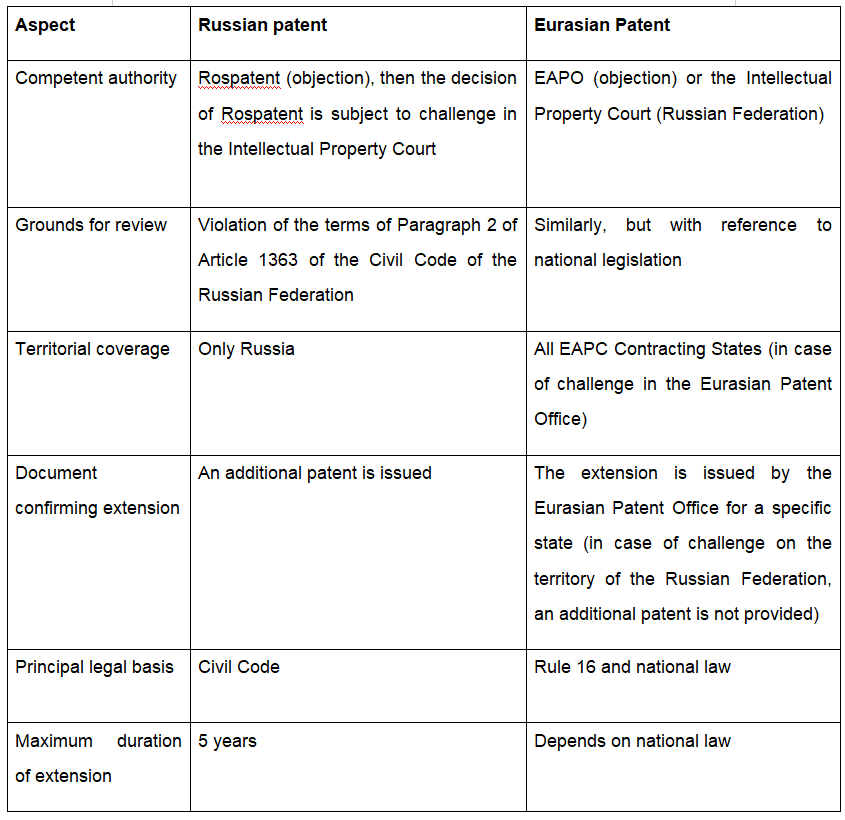
Although both the Russian and Eurasian systems pursue the same objective of compensating patent holders for regulatory delay, they differ significantly in institutional design. The Russian model is centred on national administrative procedures before Rospatent, whereas the Eurasian mechanism distributes regulatory functions between the EAPO and national legal systems. This institutional distinction largely explains the differences in judicial review and the allocation of jurisdiction over patent term extension disputes.
Table 1: Comparison between Russian and Eurasian Patent Term Extension Systems
Conclusion
The development of patent term extension mechanisms in Russia and the Eurasian patent system demonstrates an ongoing effort to balance two competing objectives: providing effective compensation for regulatory delays while preventing unjustified extensions of patent exclusivity. Recent legislative amendments and judicial decisions have contributed to greater legal certainty by clarifying both the substantive conditions for extension and the available mechanisms for administrative and judicial review.
Nevertheless, the coexistence of national and Eurasian procedures continues to raise questions regarding jurisdiction, procedural coordination, and the consistent interpretation of applicable legal standards. As the number of patent term extension disputes increases, the further development of consistent judicial standards and greater harmonisation between national legislation and the Eurasian patent framework will remain essential for enhancing legal predictability for both patent holders and market participants. This is particularly important in the context of increasing cross-border patent activity and the growing significance of the Eurasian patent system for international applicants. In this respect, the Russian and Eurasian approaches provide a useful example of how regional patent systems may combine national substantive law with supranational administrative procedures when addressing the challenge of patent term compensation.