


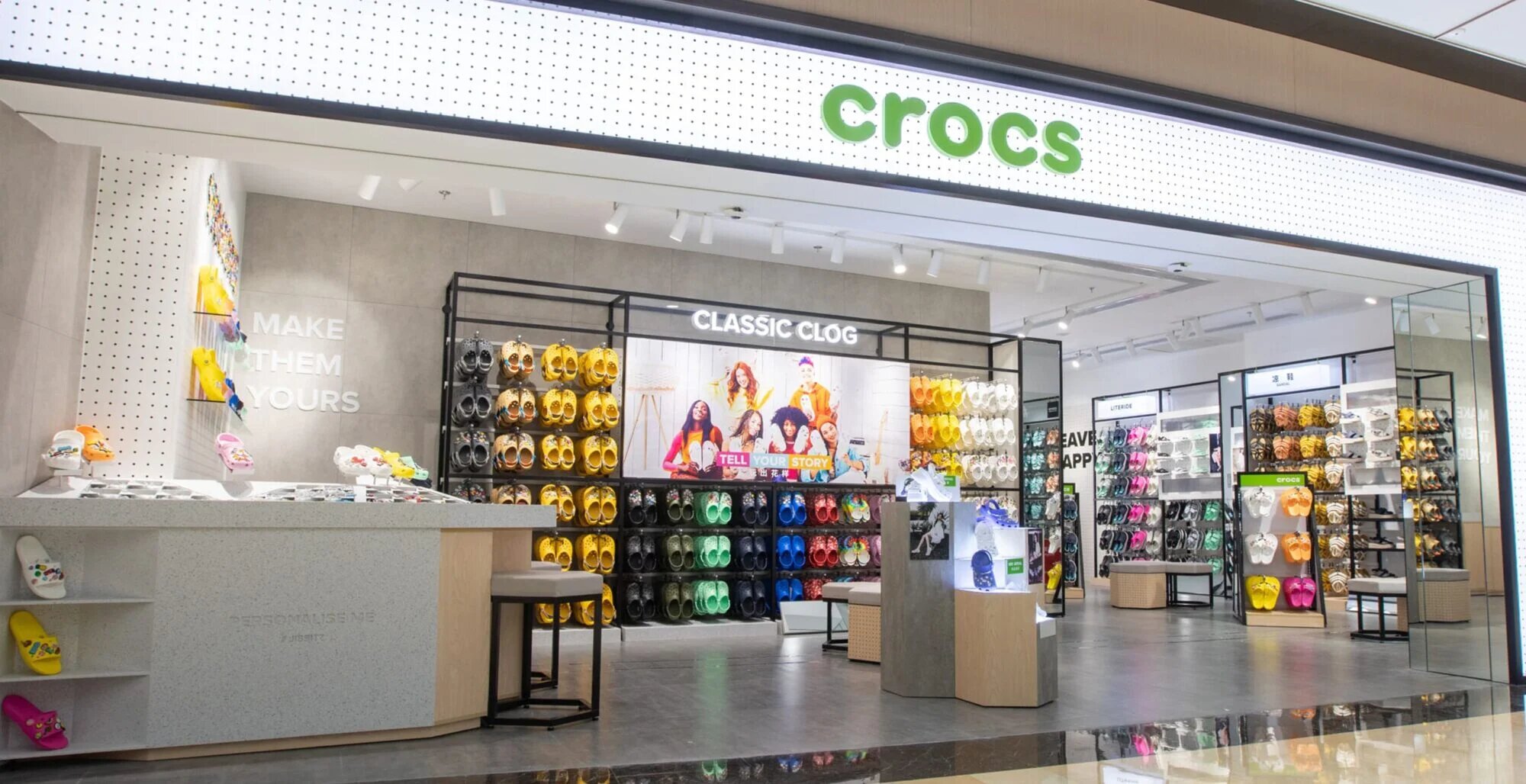
Photo source: Crocs
Recently, the Jiangsu High People's Court issued a second-instance judgment in the unfair competition dispute between Crocs Trading (Shanghai) Co., Ltd. ("Crocs") and Shanghai Hotwind Fashion Enterprise Development Co., Ltd. and related companies (collectively, "Hotwind"). The appellate court held that the clog trade dress asserted by Crocs does not constitute "well-known trade dress," and that Hotwind's production and sale of the accused clogs do not constitute unfair competition. The court reversed the first-instance judgment rendered by the Suzhou Intermediate People's Court and dismissed all of Crocs' claims.
Case Background
Hotwind is a well-known fashion retail chain brand in China, operating over 1,000 stores in 140 cities nationwide and enjoying a strong reputation among Chinese consumers. Crocs is a well-known U.S.-based footwear brand that has launched numerous sandal and slipper products on the market. Hotwind and Crocs have a certain competitive relationship in the clog and sandal business.
In October 2022, Crocs sued Hotwind before the first-instance court, the Suzhou Intermediate People's Court, alleging that 20 clog products sold by Hotwind through its offline physical stores and e-commerce channels such as Tmall, JD.com, and Douyin were highly similar in appearance to five of Crocs' products including the "Classic Clog," and "Little Whale".
Crocs distilled the trade dress of the accused footwear into three core features: (1) a wide, rounded toe box with an arc-shaped design; (2) uniformly distributed circular holes on the upper; and (3) a movable heel strap at the rear that can be freely moved forward and backward, with a circular button inlaid at the connection point between the strap and the shoe body. Crocs argued that trade dress bearing the above three features possesses the function of distinguishing the source of goods and meets the definition of "well-known trade dress" under the Anti-Unfair Competition Law. Crocs further contended that Hotwind, as a major competitor in the same industry, not only failed to reasonably design around it but instead engaged in conduct that constituted suspected free-riding on its goodwill by copying its trade dress, thereby amounting to unfair competition.
Crocs requested the court to order Hotwind to cease using packaging or trade dress that is identical or similar to Crocs' well-known product packaging and trade dress, to compensate Crocs for economic losses and reasonable expenses in the amount of RMB 15 million, and to publish corrective statements in China Market Regulation News, Consumption Daily, and on the homepages of Hotwind's e-commerce stores to eliminate any negative impact.
First-Instance Decision
In September 2023, the Suzhou Intermediate People's Court issued its first-instance judgment. The first-instance court found that the "CROCS" and "卡骆驰" (Chinese characters of CROCS) branded clogs enjoy high market recognition, and that the three core features of the trade dress of the five footwear products asserted by Crocs collectively constitute "well-known trade dress." The court also found that the trade dress of the accused infringing products bore all three of the aforementioned common features, and therefore Hotwind's conduct constituted unfair competition, ordering Hotwind to assume liability including cessation of infringement and compensation for damages. As to the amount of compensation, the first-instance court considered that Crocs' presumptive calculation method lacked sufficient evidentiary support, and ultimately exercised its discretion to order the Hotwind parties to jointly compensate Crocs for economic losses and reasonable enforcement expenses in the amount of RMB 2.5 million, while denying Crocs' request for publication of corrective statements to eliminate impact.
Appeal and Second-Instance Reversal
After the first-instance judgment was announced, both the plaintiff and the defendant appealed to the Jiangsu Provincial High Court. Crocs maintained its original claims, continuing to seek RMB 15 million in damages and requiring Hotwind to publish corrective statements in newspapers. Hotwind appealed, requesting that the first-instance judgment be vacated and all of Crocs' claims be dismissed. During the second-instance proceedings, Hotwind submitted 48 pieces of new evidence.
On May 27, 2026, the Jiangsu High Court issued its second-instance judgment, holding that the clog trade dress asserted by Crocs does not constitute well-known trade dress, and that Hotwind's production and sale of the accused clogs do not constitute unfair competition. The court vacated the first-instance judgment and dismissed all of Crocs' claims.
Grounds for Reversal
The Jiangsu High Court based its reversal on the following reasoning.
The court first articulated the legal standard for whether a product's shape may constitute protectable trade dress under the Anti-Unfair Competition Law. Under the governing framework, such trade dress generally must satisfy four conditions: (1) the shape, as trade dress, has a certain market influence; (2) the shape has actually acquired source-distinguishing function; (3) the shape is not solely dictated by the nature of the product itself, required to achieve a technical effect, or a shape that gives substantial value to the product; and (4) use of such shape by others is likely to cause consumer confusion as to source. Among these, the recognition and distinctiveness of trade dress are affected by its actual use.
Applying this standard, the court held that Crocs, as the party seeking protection for its allegedly influential product trade dress, bore the burden of proving that at the time of the alleged infringing conduct (April 2021), the asserted trade dress had a certain market influence and that relevant consumers could distinguish product source by it. The evidence submitted by Crocs was insufficient to meet this burden, as specifically analyzed below:
First, with respect to Crocs' advertising and promotion, the evidence submitted by Crocs was insufficient to prove that it had extensively promoted the asserted trade dress. Only a small amount of evidence reflected the asserted trade dress, and the scope of impact was relatively limited. It was difficult to prove that the trade dress of the five asserted clog styles had, on its own, acquired source-identifying significance in the perception of the relevant public.
Second, with respect to Crocs' financial statements and sales performance, Crocs' evidence failed to prove the sales volume of the five clog products bearing the asserted trade dress, and the ranking of the "CROCS" brand cannot be equated with the ranking of footwear products bearing the asserted trade dress.
Third, with respect to Crocs' own understanding of the asserted trade dress, certain media reports indicated that Crocs itself recognized that the asserted trade dress possesses certain technical effects.
Fourth, with respect to Crocs' enforcement history, Crocs' evidence involving trade dress protection included only two cases. Other evidence either reflected that the timing of complaints or enforcement actions was after April 2021, or primarily targeted trademark infringement enforcement. The reputation of a trademark should not be equated with the reputation of the asserted trade dress.
Ultimately, the second-instance court held that the "CROCS" brand encompasses numerous footwear styles, and the evidence submitted by Crocs was insufficient to prove that at the time of the alleged infringing conduct, the products bearing the trade dress of the five asserted clog styles possessed sufficient market influence to have established a stable corresponding relationship in consumers' perception and to serve as source identifiers. Therefore, the asserted trade dress does not constitute "well-known trade dress" as defined in the Anti-Unfair Competition Law. Accordingly, the second-instance court concluded that the first-instance judgment erred in its determination of whether the asserted trade dress constitutes well-known trade dress, and vacated the first-instance judgment and dismissed all of Crocs' claims.