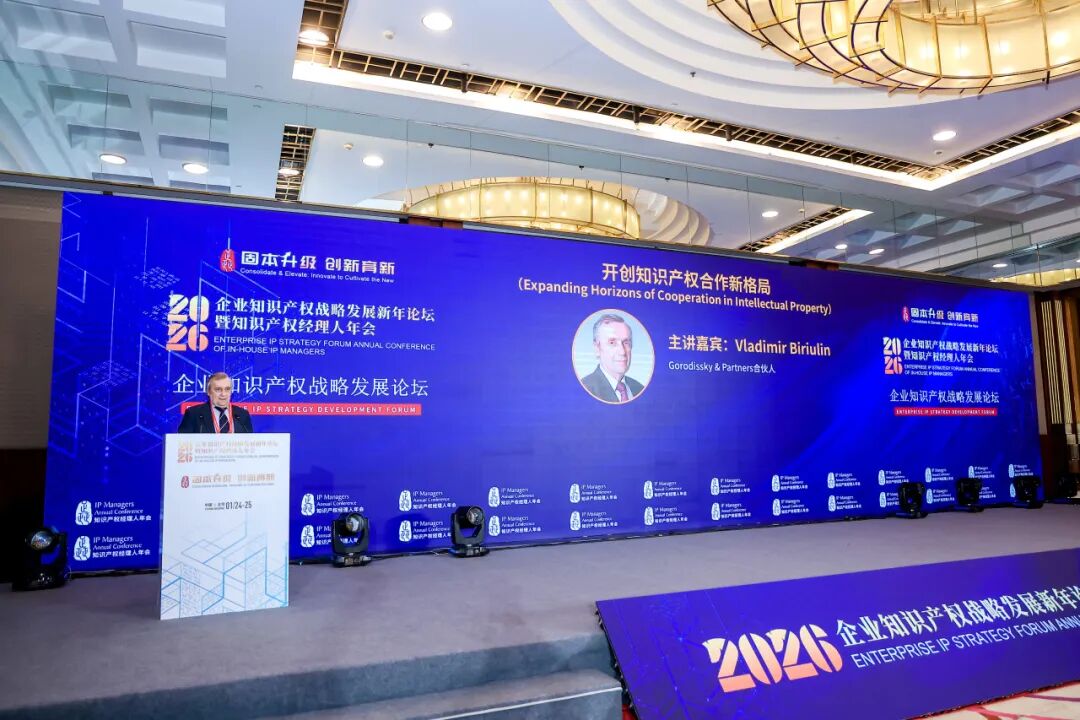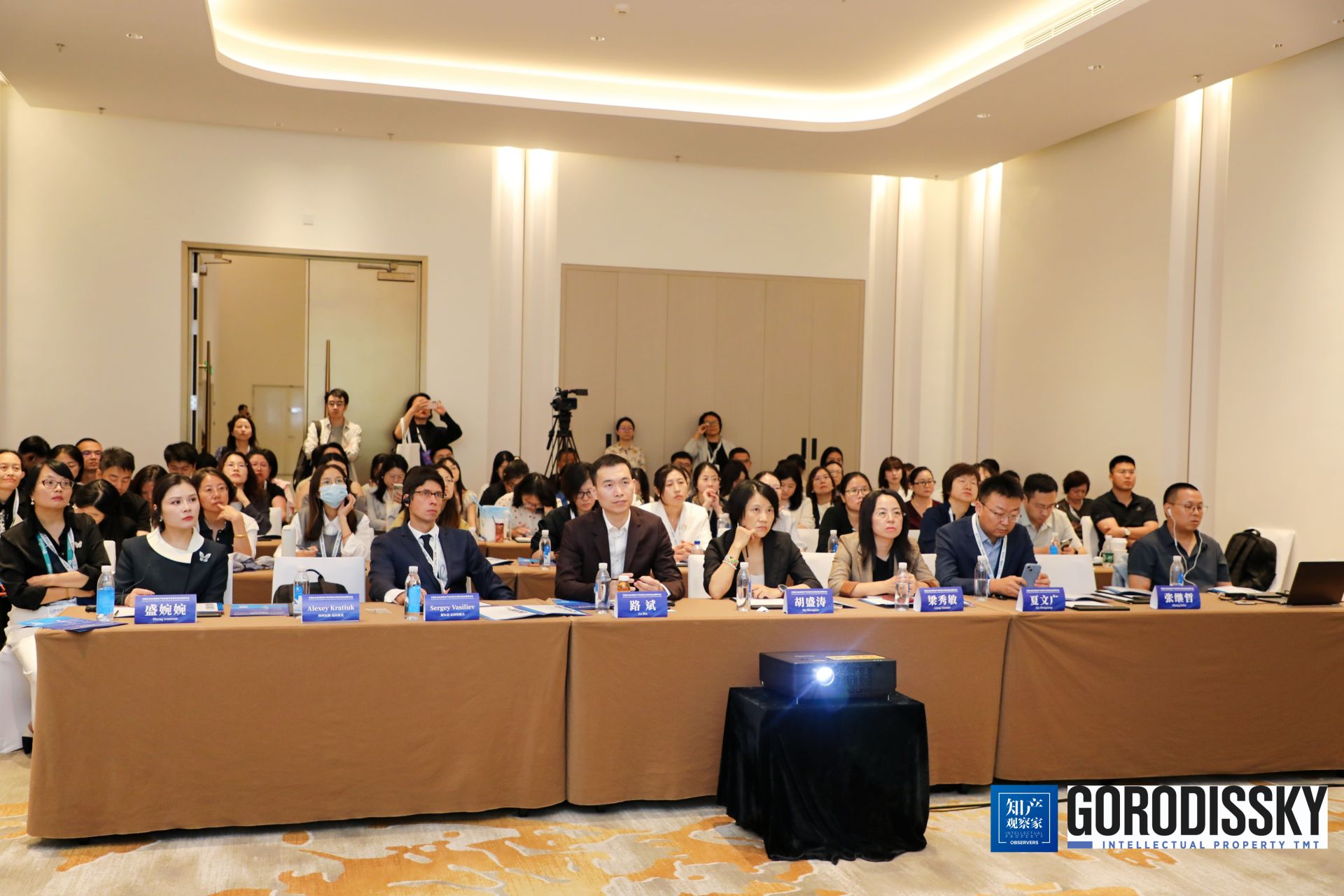


On January 24–25, the 2026 Enterprise IP Strategy Forum & Annual Conference of In-house IP Managers was held at the Beijing International Hotel. Under the theme "Consolidate & Elevate: Innovate to Cultivate the New," the event brought together industry leaders, experts, and premier institutions. It offered attendees three core benefits: trend insights, resource matchmaking, and capacity building — positioning itself as a vital platform for seizing industrial upgrading opportunities. A total of 420 guests from various sectors gathered to witness the forum's highlights.
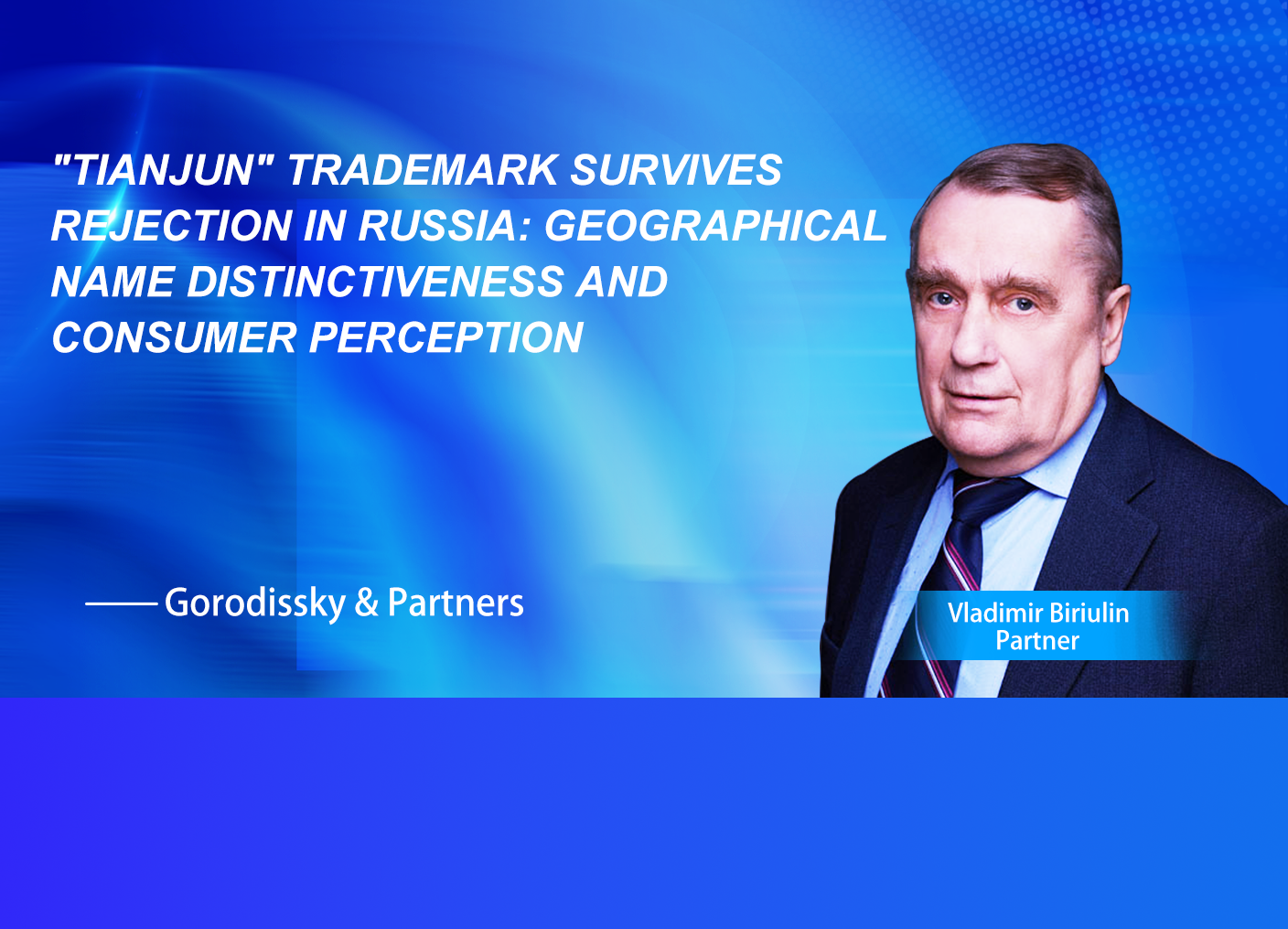
During the main session, the "Enterprise IP Strategy Development Forum," Vladimir Biriulin, Partner at Gorodissky & Partners, delivered a keynote speech. The editorial team of Intellectual Property Observers has curated and transcribed his remarks for our readers:

It is a great honor to speak before such a distinguished audience. Today, I will focus on how Chinese companies can better navigate business operations in Russia while avoiding risks such as IP infringement.
Recently, I noticed an interview by Intellectual Property Observers with Dr. Lorenz Kaiser, Senior Legal Counsel at GE Aerospace, discussing the balance of IP management and R&D collaborations. Geographically, over three-quarters of Russia’s territory lies in Asia, sharing a long border with China — a proximity that fosters abundant opportunities for bilateral cooperation.
Allow me to share some key figures on China-Russia trade. In 2024, the number of Chinese companies registered in Russia grew substantially, with many investing in local manufacturing. Joint venture projects have increased across various sectors — coal mining in East Siberia and the Far East, Norilsk Nickel's copper metallurgy facilities in China, and collaboration in oil and gas, chemicals, automotive, electric vehicle manufacturing, and space exploration. In terms of China's exports to Russia, machinery and equipment account for over 60%, followed by light industrial and chemical products.
Cooperation extends beyond industry into culture. For instance, China loaned giant pandas Ding Ding and Ru Yi to Russia; the female cub was named Katyusha. Meanwhile, a growing number of Russian schools offer Chinese language courses, reflecting increased interest in Chinese culture. In the IP field, collaboration between Chinese and Russian experts has deepened. Last December, the Joint China-Russia Working Group on IP addressed topics of mutual concern.
On IP filings, Chinese companies submitted approximately 1,300 patent applications in Russia in 2024, compared to fewer than 900 from U.S. firms. In trademark filings, Chinese enterprises filed about 7,500 applications, while U.S. companies submitted around 1,500. Many Chinese brands have registered trademarks in Russia for products ranging from automobiles and computers to smartphones and watches. I personally own a Chinese-made watch that I have worn for years — its quality rivals that of many Swiss timepieces, at a more reasonable price.
Now, let me turn to the IP protection landscape in Russia. Invention patents can be pursued via the national route or the Eurasian route. The Eurasian route applies to eight former Soviet states, and the language of prosecution is Russian. The Eurasian route offers broader territorial coverage and procedural continuity.
Trademark registration can be done nationally or through the Madrid System. Trademarks not used for three consecutive years may be revoked. Since trademark rights are tied to market presence, non-use can lead to cancellation by the IP Court. Generally, business operations run smoothly, but entering a new market carries risks. For instance, a Chinese company may engage a local distributor to sell its products in Russia. Initially, all goes well. However, when demand rises, the distributor may register the Chinese company’s trademark under his own name. This can lead to risks such as import bans or attacks on other distributors. The original rights holder must then file a complaint with the patent office or IP Court to defend its rights. I can share a specific case later.
In IP transactions, common mechanisms include assignment, licensing, and franchising. Assignment transfers all rights; licensing grants usage rights; franchising conveys a bundle of rights, including trademarks. Recommended steps for IP transactions: conduct IP due diligence and detailed review, negotiate and reach consensus with the counterparty, then proceed with other implementation procedures — all essential for business operations.
My recommendations for Chinese companies: Before entering the Russian market, conduct a comprehensive trademark search. File trademark applications in all target Eurasian Economic Union countries. Partner with local law firms to avoid unknown pitfalls and risks. During operations, continuously enforce rights: train local distributors to identify counterfeit goods, monitor major e-commerce platforms, and take decisive legal action against major infringers to set a precedent.
Enforcement avenues include administrative, criminal, civil, and unfair competition measures. As for IP Court jurisdiction: the court of first instance hears appeals against patent office decisions, patent and trademark revocations (excluding matters handled by the patent office, such as errors in inventor information or bad-faith trademark registrations). The appellate instance reviews cases adjudicated by the IP Court as the court of first instance and IP infringement cases from lower commercial courts.
Regarding litigation timelines, typically, the first instance takes 6–8 months, the second instance 2–3 months, the IP Court approximately 6 months, and the Supreme Court 3–8 months. Civil remedies include injunctions, cessation of infringement, removal from circulation, and destruction of counterfeit products, trademarks, packaging, infringing equipment, and materials. Rights holders may recover full actual losses and lost profits. An alternative to damages is compensation (statutory damages) in which case the plaintiff may claim double cost of infringing goods. The court may narrow down the compensation depending on the circumstances. Court rulings may be published. In cases of repeated infringement, the infringing entity may face liquidation of the legal entity.
Let me now turn to an unfair competition case — one that some companies encountered in trademark disputes. A Korean company registered the trademark "GOM Ace" in South Korea in 2005 for water heaters. In 2008, it entered into a sales contract with a Russian operator. In 2013, the Russian operator registered the " " trademark in its own name for commercial use. The Korean company registered two "NAVIEN ACE" trademarks in 2016 and 2021; the Russian operator opposed both and successfully revoked them. The Russian operator then offered to sell the trademark to the Korean company for €150,000, which was declined. Subsequently, the Russian operator sued the Korean company for trademark infringement and was awarded 4 million rubles. The Korean company countersued for unfair competition; the Russian operator’s trademark was invalidated and its conduct deemed unfair competition. The IP Court ultimately restored the Korean company’s trademark rights to "NAVIEN ACE."
Another case involves the well-known Chinese brand LABUBU. The Chinese company is actively fighting against counterfeit toys. Russian company filed an application for a similar trademark, CHEBUBU. It is still pending. We have also collaborated with Chinese companies across various fields. I want to emphasize once again: cooperation between Chinese and Russian enterprises is proceeding very smoothly, but IP protection must be treated with the utmost seriousness. The Intellectual Property Observers multimedia platform is a vital channel for helping Chinese companies gain a deeper understanding of the Russian business environment. In 2025, we published 12 column articles on IP protection in Russia on this platform. Once again, I extend my sincere thanks to Intellectual Property Observers. Thank you!