

The amendments effective from 1 July 2026, under Regulation (EU) 2026/715, which replaces Regulation (EC) No 6/2002, complete the most extensive reform of the European design system in the past twenty years. They create new protection opportunities for businesses, designers and intellectual property practitioners, while also introducing new requirements for the management and commercialisation of intangible assets.
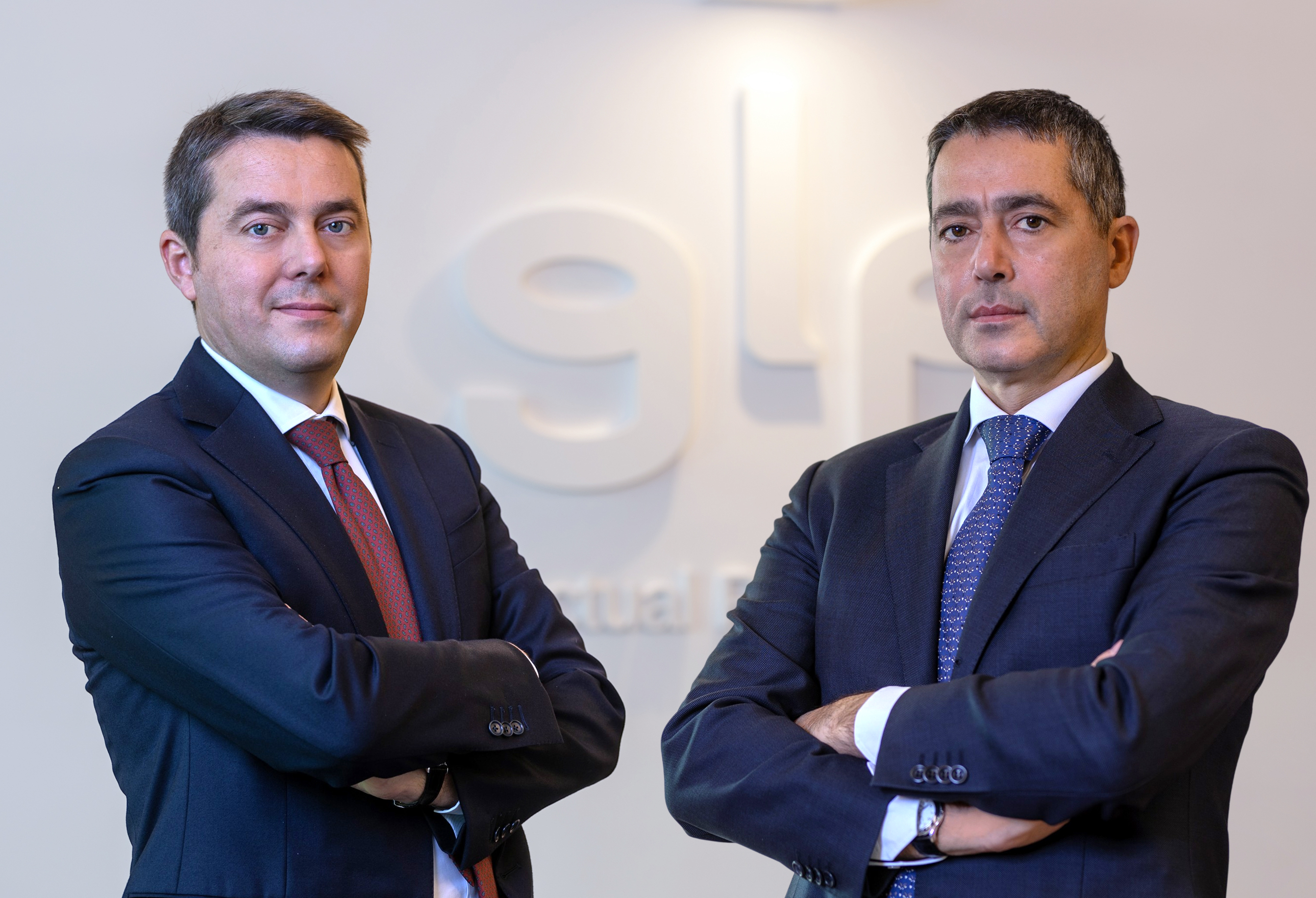
Davide L. PETRAZ(Right)and Daniele G. PETRAZ(Left), Co-managing Partners of GLP
From aesthetics to competitive advantage: the European Union design enters the digital age
Design protection is not merely a means of safeguarding the outward appearance of products. More than ever, design is a strategic asset capable of generating value and competitive advantage.
Many businesses appear to have recognized these benefits. In 2025, the European Union Intellectual Property Office (EUIPO) received a record number of more than 130,000 EU design applications. China, accounting for approximately 30% of filings, was the leading source country for EU design filings.
With these amendments in force, and with EU Member States required to transpose Directive (EU) 2024/2823 into national law by 9 December 2027, new forms of representation have been introduced, protection has been extended to digital and virtual objects, tools for combating online infringement have been strengthened, and numerous procedural aspects have been simplified.
The reform will have a practical impact on the protection strategies of businesses that leverage innovation, seek to enter new markets or market segments, and prepare to combat infringement. For example, businesses promoting their products at European trade fairs will be able to rely on a more comprehensive and precisely defined right, better suited to demonstrating both the novelty and the individual character of a product.
Protection is no longer confined to physical products. It also extends to intangible and digital elements through which the protected product is represented, including graphical user interfaces (GUIs), logos, graphic symbols, surface patterns, digital environments and animations.
New definitions of “design” and “product” under Article 4 of the Regulation
To this end, the definitions in Article 4 EUDR have been extended as follows:
· “Design” (Article 4(1) EUDR) now also includes animation, understood as the movement or transition of one or more features of a design. This may consist of a progressive change in the visual elements, irrespective of whether they retain their original identity.
· “Product” (Article 4(2) EUDR) now also includes non-physical items. A product is any industrial or handicraft item, other than a computer program, regardless of whether it is embodied in a physical object or materializes in a non-physical form.
These changes are particularly relevant to the software, gaming, automotive, augmented reality and digital services sectors, as well as to any field in which competitive value is increasingly linked to the user experience rather than solely to the physical product.
New means of representation: 3D files and video
As a consequence of the expanded subject matter, the reform also substantially updates the filing requirements.
In addition to traditional static images, 3D files and video files are now admissible, enabling complex designs, animations and digital products to be represented more accurately.
At the same time, the maximum number of views that may be used to represent a design has increased from seven to ten. This gives right holders additional means of highlighting distinctive features and defining the scope of protection more clearly.
Visible representation remains a relevant requirement: the features for which protection is sought must be visibly shown in the application, although they do not necessarily have to remain visible throughout every stage of the product’s use. The exception continues to apply to component parts of complex products, which must remain visible during normal use.
More flexible multiple applications
One of the changes most welcomed by businesses is the removal of the “unity of class” requirement for multiple applications. Applicants may now include products belonging to different classes of the Locarno Classification in a single application, subject only to the limit of 50 designs in each application.
For businesses with extensive portfolios, this change enables more efficient filing strategies, potentially reducing administrative costs and providing greater flexibility in the protection of diversified product lines.
Infringement: the focus now extends to digital files
Enforcement under Article 20 EUDR no longer concerns only the manufacture and marketing of physical copies. It also extends to the creation, distribution, sharing and copying of any medium or software recording the design for the purpose of enabling a product incorporating or applying the protected design to be made.
The provision is primarily intended to address issues arising from 3D printing, where dissemination of the digital file often constitutes the decisive act of infringement.
Protection is further strengthened by allowing holders of registered EU designs to act against infringing goods brought into the territory of the European Union, even where those goods are destined for third-country markets. In particular, unauthorized third parties are prohibited from:
· making, offering, placing on the market, putting into service or using a product into which the design is incorporated or to which it is applied;
· importing, exporting or stocking such products for commercial purposes;
· creating, downloading, copying, sharing or distributing any medium or software recording the design, where such activities are intended to enable the manufacture of products incorporating or utilising the design, subject to two exceptions (Article 21 EUDR) which exclude infringement:
o where the design is used solely for the purpose of identifying or referring to a product as belonging to the holder of the design right;
o where the acts are carried out for the purposes of comment, critique or parody, in order to safeguard the right to freedom of expression, provided that they fall within normal commercial practice and do not unduly prejudice the normal economic exploitation of the design.
· bringing into the territory of the European Union products suspected of infringing the design, even where those goods are not intended to be released for free circulation in the internal market.
The repair clause and the spare-parts market
The reform makes the so-called “repair clause” permanent for component parts of complex products used for the sole purpose of repairing the complex product so as to restore its original appearance (Article 22 EUDR). A complex product is “a product which is composed of multiple components which can be replaced, permitting disassembly and reassembly of the product”. In this context, design protection must not create a monopoly in the spare-parts market where the “must-match” component serves only to restore the original appearance of the complex product.
The repair clause is accompanied by an information requirement: manufacturers and sellers must clearly inform consumers of the commercial origin and the identity of the manufacturer of the component part intended for repair.
New procedures and increased digitalization
Digitalization now encompasses the entire administrative system. Physical specimens or objects may no longer be filed, and all communications with EUIPO must take place by electronic means.
For disputes, the new accelerated processing of invalidity applications that are not contested by the right holder is particularly significant, as it is intended to accelerate the cancellation of vulnerable or undefended registrations.
The new Ⓓ symbol and the change in terminology
From a communications and commercial perspective, right holders may use the new Ⓓ symbol to indicate that a design is registered. Although optional, the symbol may reinforce the perceived value of the product and have a deterrent effect on competitors.
At the same time, the former “Community design” has been officially renamed the “European Union design” (EU design).
Strategic implications for businesses and advisers
The reform changes the very way in which design protection is conceived. Existing portfolios should be reviewed in the light of the new opportunities offered by protection for digital elements, three-dimensional representations and animations. Where appropriate, the interaction between design rights and patent protection should also be considered. In parallel, businesses should assess the impact of the new rules on renewals, multiple-filing strategies and the management of online enforcement activities.
For intellectual property practitioners, the message is clear: design rights are set to assume an even more central role in the commercialisation of intangible assets, particularly in sectors characterized by digital innovation, user interfaces, virtual content and products with a strong aesthetic component. The reform provides more powerful tools, but it also requires greater care in strategic planning and rights management.
What the European Union design means for Chinese businesses
Since 2022, China has been the leading source country for EU design filings. Between 2010 and 2019, filings grew by 890.4% overall, with an average annual growth rate of 31.4%. Taking into account both direct EUIPO filings and international designations, China filed 39,144 applications in 2025, representing 29.92% of the total.
Direct EU design applications from China (2003–2025)
Source: EUIPO
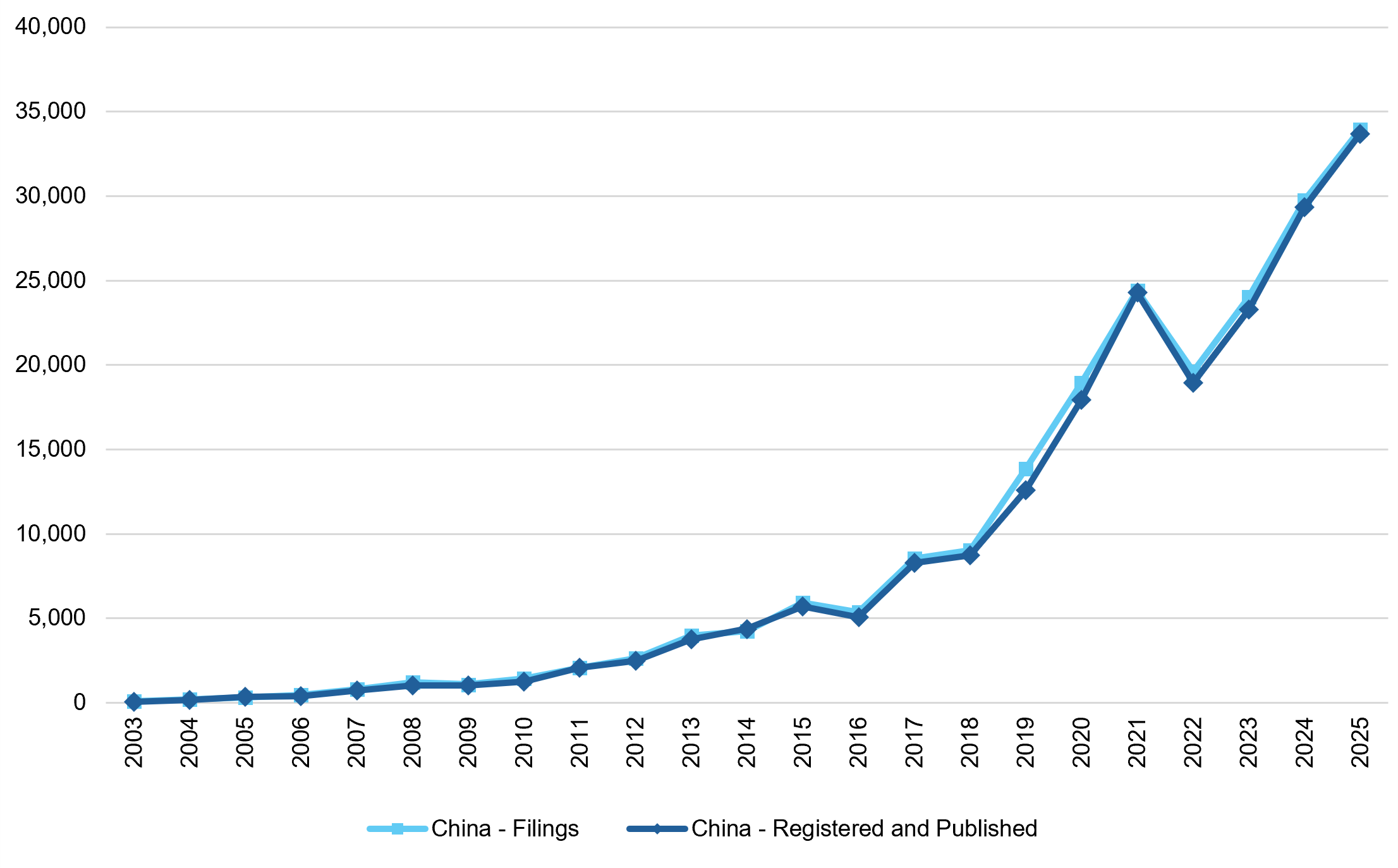
The filing figures confirm that Chinese businesses increasingly regard the European Union design as a strategic and efficient right. It offers a strong cost-benefit ratio from a competitive perspective and is readily accessible compared with other forms of intellectual property protection, owing to the short registration timeframe.
For Chinese businesses, the European Union design reform is a concrete opportunity to strengthen their presence in the European market and their enforcement options, including at trade fairs, while reducing the risk of local copying by European competitors.
We advise Chinese right holders intending to expand their business in the European Union to anticipate the national implementation of the design and define their protection strategy accordingly, particularly in sectors where the spare-parts market is central.
For more information about GLP: www.glp.eu-WeChat official account: glp.eu.